EasyDMARC Alternative: SimpleDMARC Comparison 2026
Looking for an EasyDMARC alternative? Compare SimpleDMARC vs EasyDMARC on pricing, features, and MSP support. Storage-based pricing means attack traffic never counts.

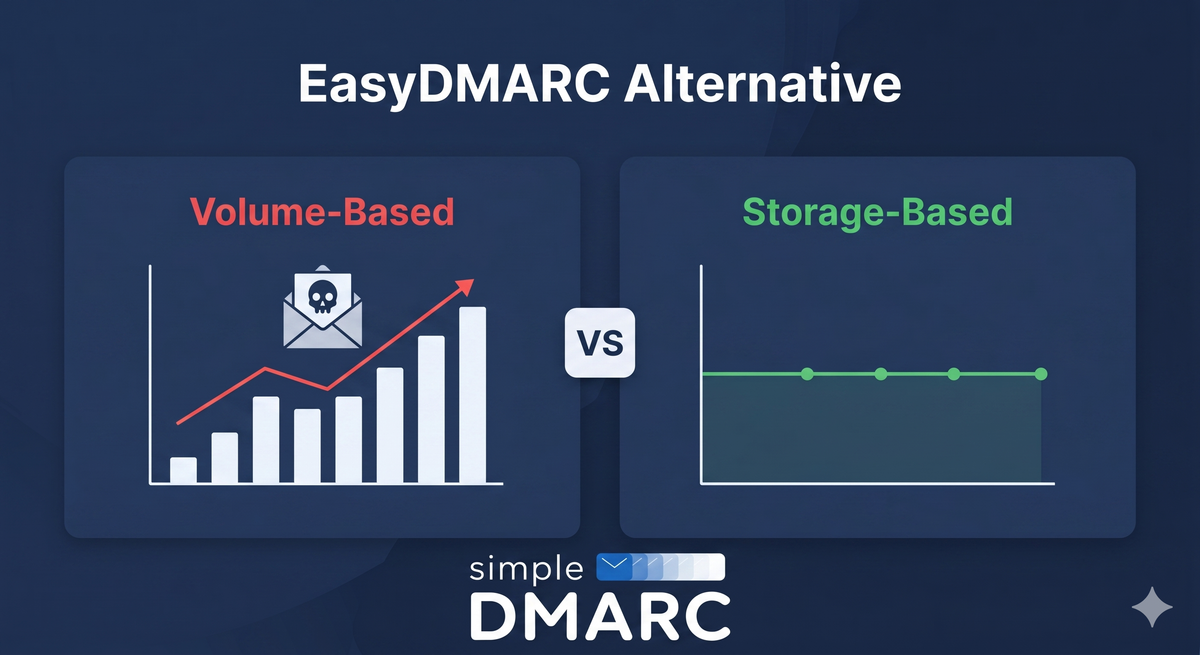
EasyDMARC is a capable DMARC platform. It has a clean dashboard, guided onboarding, and a large knowledge base. It's also built on volume-based pricing, which means every email that claims to be from your domain counts against your plan, including the spoofed phishing emails attackers send without your knowledge.
SimpleDMARC is built differently. After five years running DMARC monitoring for SMBs and MSPs, we use storage-based pricing: you pay for the report data you store, not for the volume of email that passes through. Spoofed attack traffic is excluded entirely.
That's the core difference. This article breaks down the comparison so you can decide which model fits your situation.
Why People Look for EasyDMARC Alternatives
EasyDMARC is one of the most recognized names in DMARC monitoring, and it earns that recognition. But specific situations push IT admins and MSPs to look elsewhere:
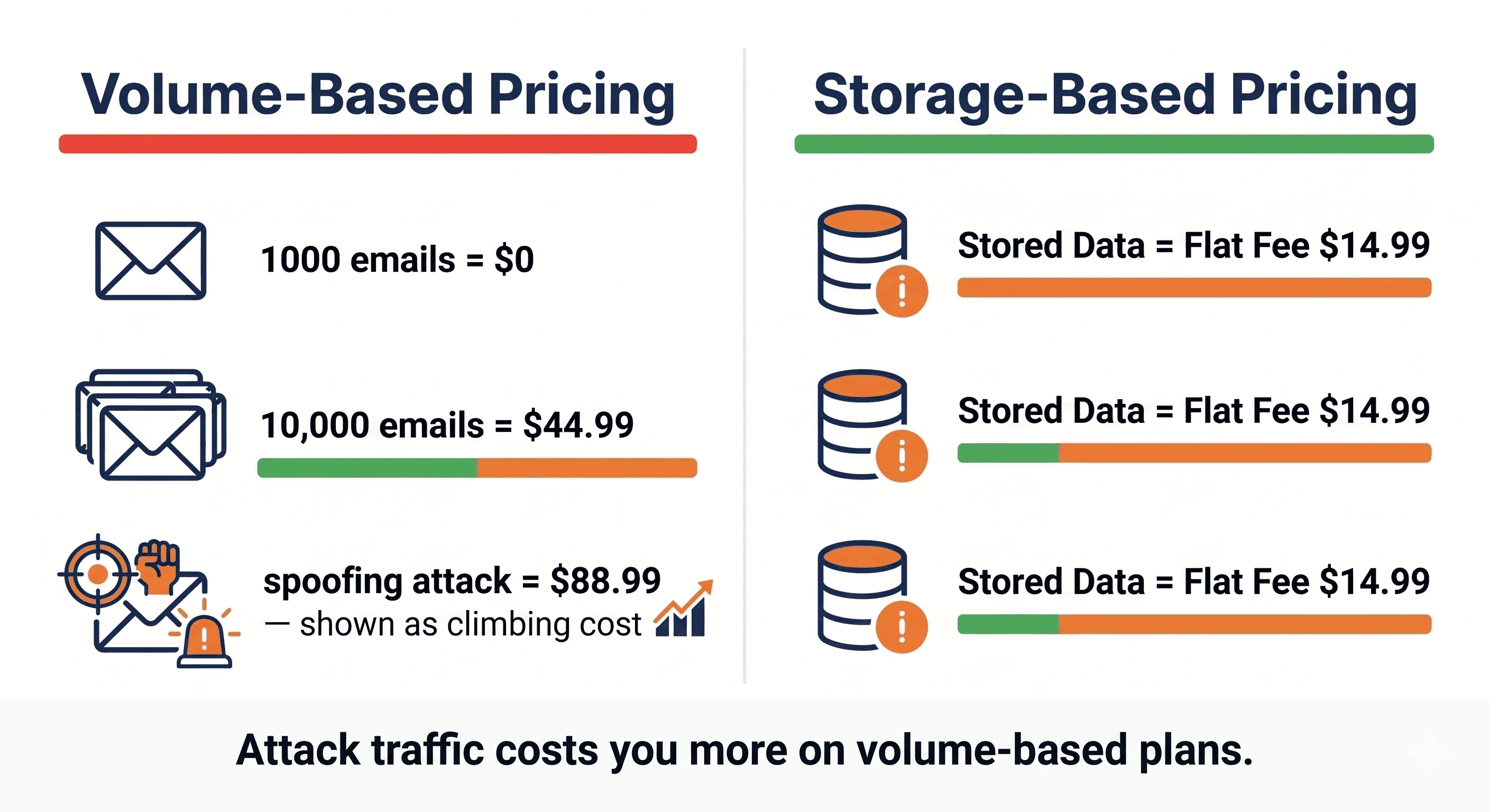
Volume-based pricing gets expensive under attack. When attackers flood your domain with spoofed emails — a common tactic to test defenses — your DMARC reports fill with those attempts. On a volume-based platform, that traffic counts against your plan. You end up paying more precisely when you're being targeted.
MSP billing gets complicated. EasyDMARC charges per domain. If you manage client domains that are parked or not actively sending email, you're paying the same rate for them as for live sending domains.
The free tool ecosystem is limited. EasyDMARC offers a DMARC checker and a few other utilities, but SimpleDMARC provides over 30 free email security tools that generate organic traffic and let potential customers self-diagnose before signing up.
None of this makes EasyDMARC a bad product. It makes it the wrong fit for specific use cases — particularly high-volume senders, domains under active attack, and MSPs managing mixed portfolios of active and passive domains.
SimpleDMARC vs EasyDMARC: Direct Comparison
| Feature | SimpleDMARC | EasyDMARC |
|---|---|---|
| Pricing model | Storage-based | Volume-based |
| Attack traffic | Excluded from limits | Counts against plan |
| Free tier | Available | Available |
| Unlimited email volume | All paid plans | Volume caps apply |
| MSP multi-tenant | Yes | Yes |
| Passive domain billing | Passive domains excluded | Charged same rate |
| Years in market | 5 years | 9 Years |
| Free tools | 30+ | Limited |
| BIMI support | Yes | Yes |
| MTA-STS hosted | Yes | Yes |
The Storage-Based Pricing Difference Explained
Most DMARC monitoring platforms — EasyDMARC included — meter usage by the number of emails they process. The logic is straightforward from a cost-of-goods perspective: more email means more data to parse.
The problem is that your email volume isn't entirely under your control. Attackers who spoof your domain generate DMARC reports. Those reports flow into your monitoring account. On a volume-based platform, you're billed for that attack traffic.
SimpleDMARC charges based on how much report data you retain, not how many emails triggered those reports. See SimpleDMARC's pricing tiers — plans scale by storage allocation and retention period, not by message count. A domain under heavy spoofing attack generates more report data than a quiet domain, but the cost difference is far smaller than under volume-based metering.
For a concrete example: if attackers send 500,000 spoofed emails from your domain in a month, a volume-based platform counts that against your plan. SimpleDMARC counts the compressed XML report data those attempts generate — typically a few megabytes — not the email count itself.
This is the unique protection in RFC 7489 that most platforms miss: aggregate reporting is designed to give domain owners visibility into authentication results, including from unauthorized sources. The monitoring tool shouldn't charge you extra for the unauthorized sources.
Which Platform Fits Which Use Case
Choose SimpleDMARC if:
- Your domain is under active spoofing attacks and you don't want billing surprises
- You send high email volumes and volume-based metering would be expensive
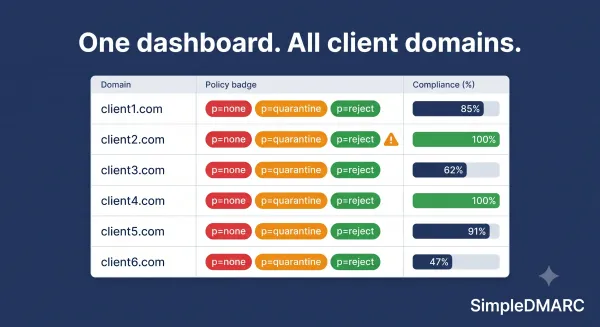
- You're an MSP with a mix of active and passive client domains
- You want access to a broad set of free tools for customer acquisition and self-service diagnostics
- You want a platform that's been running continuously for five years
EasyDMARC may fit better if:
- You want guided onboarding with a very polished UI walkthrough
- You're a small organization with predictable, low email volume
- You need EasyDMARC's specific deliverability features (inbox placement testing, blacklist monitoring) that go beyond authentication
The comparison isn't "SimpleDMARC is better." It's that the two pricing models produce meaningfully different cost profiles depending on your situation.
What MSPs Should Know
MSPs managing DMARC across multiple client domains face a specific accounting problem: not all domains send email. Clients often have parked domains from acquisitions, legacy brand names, or regional variants that need DMARC protection (to prevent spoofing) but generate no legitimate email.
On volume-based platforms, those domains still contribute to your usage calculation whenever attackers probe them. On SimpleDMARC, passive domains — domains not actively sending email — don't count toward your plan allocation.
If you're managing 50 client domains and 20 of them are parked, you're paying for 50 on EasyDMARC's model and closer to 30 on SimpleDMARC's. The arithmetic matters at MSP scale.
Feature Parity Where It Counts
For the core DMARC monitoring workflow — publishing a record, collecting aggregate reports, identifying unauthorized senders, moving from p=none to p=reject — both platforms handle the job. The free DMARC checker works before you're even a customer; run your domain through it now to see your current record status and any misconfigurations.
Report parsing is where platforms differentiate most. SimpleDMARC parses aggregate XML reports automatically and presents sender source breakdowns, authentication pass/fail rates, and policy compliance percentages without requiring you to interpret raw data. The storage model means retention periods are explicitly part of your plan, not hidden behind record count caps.
DKIM and SPF alignment checking, subdomain coverage, and BIMI support are all present. MTA-STS hosted records are available on paid plans.
Making the Switch from EasyDMARC
If you're currently on EasyDMARC and want to evaluate SimpleDMARC, the transition doesn't require any DNS changes to start. Sign up for a free SimpleDMARC account, add your domain, and update the rua= address in your DMARC record to point at SimpleDMARC's reporting endpoint. Reports start flowing in within 24–48 hours.
You can run both platforms in parallel by adding SimpleDMARC's reporting address alongside EasyDMARC's in your DMARC record — DMARC allows multiple rua= addresses separated by commas:
v=DMARC1; p=quarantine; rua=mailto:reports@easydmarc.com,mailto:reports@simpledmarc.com; fo=1;
That lets you compare dashboards before committing to a switch.
FAQ
Is SimpleDMARC a direct competitor to EasyDMARC?
Yes, both are DMARC monitoring platforms. The primary differences are pricing model (storage vs volume), passive domain billing for MSPs, and the breadth of free tools SimpleDMARC offers for self-service diagnostics.
Does SimpleDMARC have a free tier?
Yes. The free tier supports a single domain with basic monitoring and access to all 30+ free email security tools. No credit card required to start.
What happens to my data if I switch?
Switching involves updating the rua= address in your DMARC DNS record. Historical report data from EasyDMARC stays in EasyDMARC — SimpleDMARC collects new reports from the date you switch. Historical data portability isn't available, which is true of most DMARC platforms.
Can I run SimpleDMARC alongside EasyDMARC temporarily?
Yes. Add SimpleDMARC's reporting address to your existing rua= tag alongside EasyDMARC's. Both platforms receive reports simultaneously, letting you evaluate without disruption.
How does SimpleDMARC handle large report volumes under attack?
Attack traffic generates more DMARC report data, but SimpleDMARC's pricing is based on compressed storage of that data — not the email count. A sustained spoofing campaign produces a measurable but bounded increase in stored report data, not a linear cost increase with the attack volume.
Is SimpleDMARC suitable for enterprises or just SMBs?
SimpleDMARC works for any size — the storage model is particularly favorable for high-volume senders and MSPs. Enterprise customers with compliance requirements (PCI DSS, HIPAA, SOC 2) benefit from the retention period guarantees built into each plan tier.