SimpleDMARC Launches on Microsoft Azure Marketplace, Streamlining Email Authentication and Security
Unleash the Potential of SimpleDMARC's Microsoft Azure Marketplace Launch. Elevate Email Security through Streamlined Authentication and Protection.
Email Deliverability
Introduction: This year we completed the 50th year of e-mail, let's talk about E-mail's Innovation and future. In these decades, we have seen the difference in the evolution of the e-mail journey. There is controversy about the innovator of E-mail. Mr. Ray Tomilson and Mr. Shiva
DMARC
DMARC is the abbreviation of Domain-based Message Authentication and Reporting and Conformance. It is an email authentication protocol. DMARC uses SPF (Sender Policy Framework) and DKIM (DomainKeys Identified Mail) to authenticate the emails sent by the respective Domain. DMARC helps you to protect against unauthorized use of Domain, especially in
DMARC
Introduction In today’s digital landscape, organizations face an ever-growing threat from cyber criminals seeking to exploit vulnerabilities and compromise sensitive data. Two major business concerns are email authentication and the increasing prevalence of ransomware attacks. This article aims to shed light on these issues and provide insights into how
DMARC
Secure Your Email Marketing with DMARC: How It Works and Why It’s Essential for Businesses Introduction At SimpleDMARC, we understand the importance of email marketing as a tool for businesses to engage with their customers. However, as email phishing and spoofing become more prevalent. It is crucial for businesses
DMARC
Emails have become a vital mode of communication in today’s world. However, with the increasing instances of email phishing and spoofing attacks, ensuring email communication’s security has become more critical than ever. One way to achieve this is by using DMARC, which stands for Domain-based Message Authentication, Reporting,
Email Deliverability
Introduction for SPF: SPF (Sender Policy Framework) is a crucial element of email authentication that helps prevent email fraud and spoofing. As the use of email has become more common in our everyday lives, it has also become a preferred tool for cyber criminals to launch phishing and spam attacks.
DMARC
Introduction As more and more organizations adopt DMARC, it’s crucial to be aware of the common issues that can arise during its implementation. DMARC helps prevent email spoofing and phishing attacks by verifying that an email message actually comes from the domain it claims to come from. Despite the
DMARC
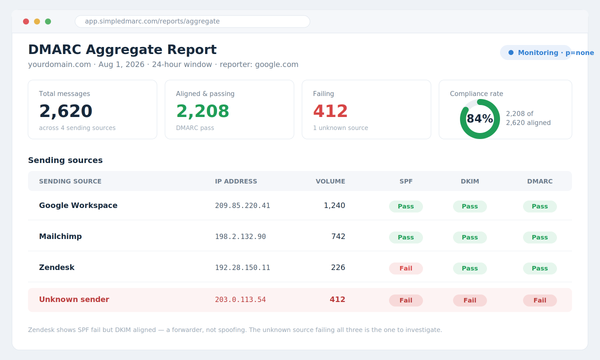
A simple, low-risk way to deploy DMARC: start at p=none, read your aggregate reports, fix legitimate senders, then move to quarantine and reject without breaking email.
Analyze DMARC
Introduction to DMARC DMARC is an email authentication protocol that uses SPF (Sender Policy Framework) and DKIM (DomainKeys Identified Mail) to verify the authenticity of the email sender’s domain. DMARC provides an additional layer of security by specifying how the receiver should handle messages that fail authentication, which can
Analyze DMARC
Email spoofing is a common technique used by cyber criminals to send fraudulent emails, and it can be a serious threat to your organization’s security. DMARC (Domain-based Message Authentication, Reporting, and Conformance) is a powerful email authentication protocol that helps protect your domain from email spoofing and phishing attacks.
Antiphishing
Introduction: Phishing attacks are one of the most common cyber crimes today, and they can cause a lot of damage to individuals and businesses. Phishing scams involve tricking people into giving away their personal or sensitive information, like login credentials, credit card numbers, or social security numbers. These scams can